In the cultural mapping of West Africa in 2026, preserving performing arts and sonic heritage holds a central place in the visitor experience. At the heart of this creative effervescence, the traditional music and rhythms of Benin represent one of the most vibrant, complex, and influential artistic expressions on the continent. For musicologists, ethnomusicologists, and lovers of authentic soundscapes, understanding the diversity of percussion and ritual chants is an essential step toward capturing the soul of the Beninese people. Through this comprehensive guide, we invite you to listen to the heartbeat of the nation, from the sacred drums of the southern convents to the pastoral flutes of the northern mountains.
1. Conceptual Foundations of the Traditional Music and Rhythms of Benin
The fundamental principle governing the traditional music and rhythms of Benin relies on the complete absence of boundaries between art, the sacred, and daily life. Beninese music is not designed as simple passive entertainment; it is a coded communication channel with ancestors, deities, and the community. Every rhythm serves a precise social or spiritual function: celebrating a birth, accompanying a dignitary’s funeral, invoking natural forces, or pacing field labor. Discovering the traditional music and rhythms of Benin thus means learning to decipher a musical language of unparalleled rhythmic sophistication.
2. The Tchinkounmey Rhythm and the Abomey Heritage
The first essential stop on this acoustic journey brings us to the heart of the former Kingdom of Danxome. The traditional music and rhythms of Benin is embodied here by Tchinkounmey, a royal funeral rhythm originally created to console grieving families at court. This style uses unique percussion instruments such as the Gô, a water gourd struck with a rubber shoe to produce a deep bass, as well as the Sato, a giant drum standing over two meters tall. Tchinkounmey performances, often held near the Royal Palaces of Abomey, offer a striking visual and acoustic spectacle.
3. Sacred Vodoun Cadences: Zinli and Sato
In the regions of Cotonou, Ouidah, and Porto-Novo, the traditional music and rhythms of Benin is closely intertwined with the sacred culture in Benin. The Zinli rhythm, characterized by the use of a clay pot struck by hand and accompanied by iron bells (Gankogui), was the favored rhythm of the Kings of Porto-Novo. Similarly, the complex polyrhythms performed during Gounnounko or Zangbeto mask ceremonies demonstrate impressive technical mastery. Drums do not merely keep time; they “speak” by mimicking the pitch tones of local languages like Fon or Goun.
4. Northern Melodies: Tipenti and Bariba Soundscapes
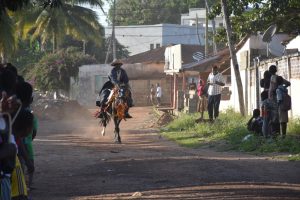
Traveling northward, the traditional music and rhythms of Benin morphs under the influence of the Baatonu and Peul peoples. In the Natitingou region and the Atakora mountains, the Tipenti rhythm sets the pace for joyful dances and harvest celebrations. Wooden drums covered with goat skin blend with bamboo flutes and royal Kakaki trumpets—long brass horns measuring up to three meters. These majestic sounds accompany the traditional equestrian parades of the Gaani festival in Nikki, offering a sonic display of rare elegance.
5. The Challenge of Digital Preservation and Intergenerational Transmission
There is a major technological and heritage challenge concerning the traditional music and rhythms of Benin: the risk of extinction for rare rhythms following the passing of elder master drummers. Without systematic archiving, entire sections of this oral memory could fade away. This is why cultural stakeholders, drawing on advances in the digitalization of art and crafts in Benin, are creating digital sound archives and dedicated streaming platforms. These initiatives ensure traditional rhythms are recorded in high definition to be passed on to future generations of musicians.
6. Global Influence: From Traditional Rhythms to Afrobeat and Jazz
The cultural footprint of the traditional music and rhythms of Benin extends far beyond national borders. This rhythmic legacy served as fertile ground for internationally renowned artists like Angélique Kidjo or the Orchestre Poly-Rythmo de Cotonou. By fusing ancestral polyrhythmic structures with Jazz, Funk, and Salsa, Benin birthed unique musical genres. Today, the young Beninese music scene continues to reinvent these traditional cadences, integrating them into contemporary Afrobeats.
7. Music Festivals at the Heart of Tourism Circuits
Promoting the traditional music and rhythms of Benin involves creating key cultural gatherings. Integrating live performances into sustainable tourism circuits in Benin allows visitors to join percussion workshops or experience the intensity of local festivals. These events ensure direct and fair compensation for dance troupes and drum artisans, while fostering an authentic and respectful cultural exchange.
8. Semantic Optimization and SEO Power of Musical Heritage
Strategically incorporating the focus keyword traditional music and rhythms of Benin into your content architecture significantly enhances your platform’s organic rankings. Search engines reward in-depth content exploring intangible cultural heritage. By publishing articles enriched with audio samples, traditional instrument glossaries, and local artist biographies, you attract an audience passionate about ethnomusicology while reinforcing your site’s overall topical authority.
Conclusion: Let the Drums of Benin Move You
In conclusion, the traditional music and rhythms of Benin is the vibrant soul of the nation, a moving poetry connecting the past, present, and future. Listening to these rhythms is receiving a lesson in history and spirituality through the magic of sound. On our tourism platform, we incorporate custom musical immersions into our itineraries so you can feel the full power of these age-old cadences and take home unforgettable memories of the Beninese symphony.